01 / Nominal completion
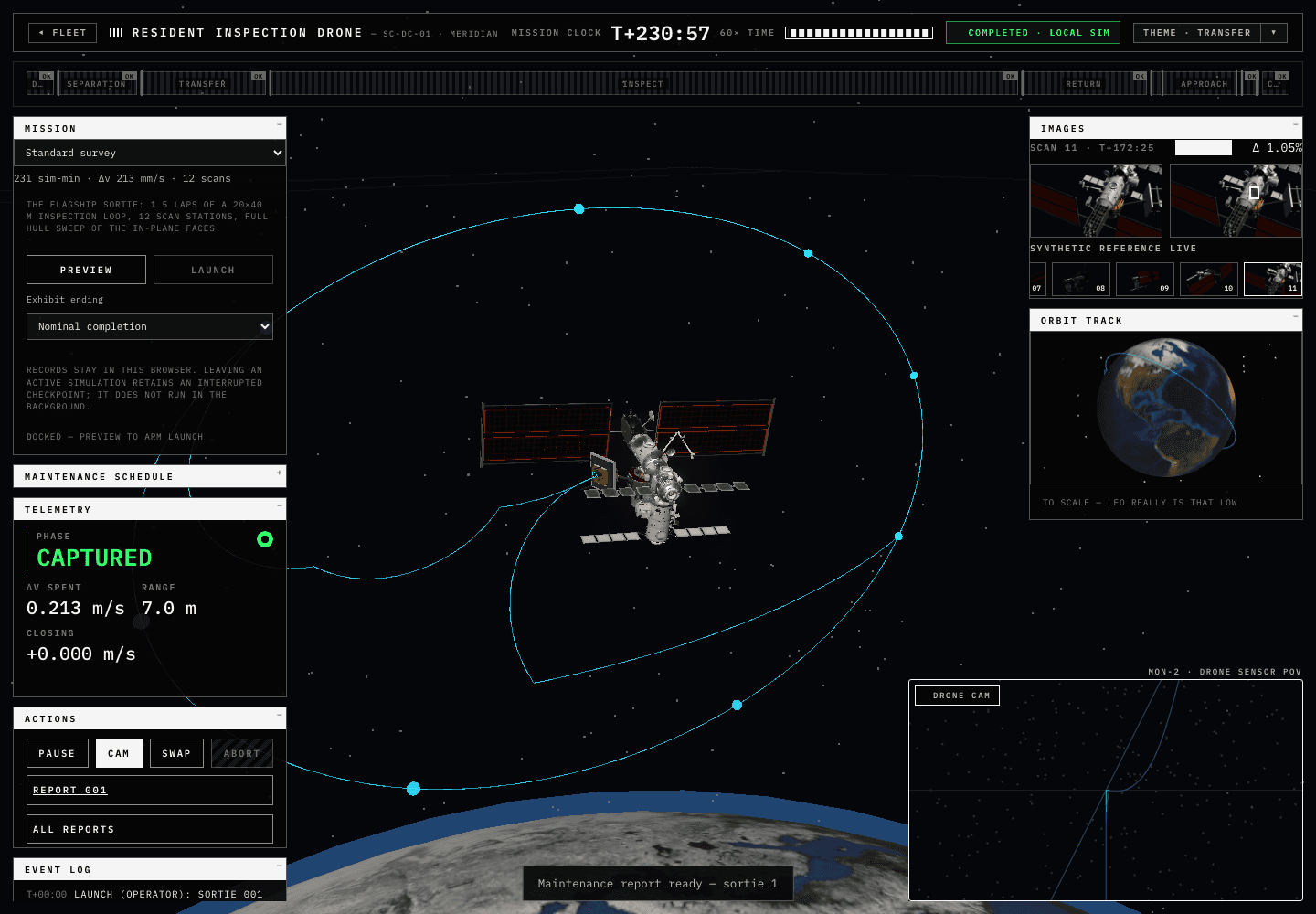
The vehicle returns to capture. Twelve scans and four seeded findings remain linked to their run.
Read the completed-run reportA resident drone that stays with its host, checks its condition and brings back evidence someone can act on. A personal concept explored through systems design and simulation.
A telemetry anomaly can reveal that something has changed without showing what the hardware looks like. I started ANGEL to explore what a spacecraft could gain from carrying its own repeatable inspection capability. Could a visual record make an uncertain maintenance decision easier to understand?
The concept is a small autonomous free-flyer that launches with its host and lives in a garage on the structure. It would undock on a schedule, inspect the exterior, compare observations with earlier scans, then return and recharge. Visual and thermal inspection are proposed capabilities; the current demo explores synthetic visual inspection.
Launching with the host removes the need for a separate long-range rendezvous. The mission stays close to a known structure, with a defined home and docking interface. The garage, host-side mounting, power and data connection are part of the system concept—not accessories added after the vehicle.
I focused the first version on inspection, with contact limited to its own dock. The proposed vehicle separates translation through nitrogen cold-gas thrusters from pointing through reaction wheels. Avoiding combustion products informed that choice; plume and contamination behavior remain hardware questions.
Loss of thrust also shaped the concept. Passive drift constrains the modeled inspection trajectories, while docking uses separate approach checks. Some aborts require a departure burn before coasting. Those are specific model behaviors, rather than an unconditional safety guarantee.
I explored the concept’s fit across roughly 30 space companies. That narrowed my customer hypothesis toward commercial crewed-station operators, with Vast and Axiom as examples to investigate. The condition of a crewed structure gives a repeatable inspection record a particularly consequential use case.
That shifted my framing toward evidence that could support maintenance, assurance and eventually certification or insurance decisions. Demand and acceptance of that evidence remain unproven. A repeatable host connection is part of the integration concept, not an established ANGEL standard.
I built a browser simulation of release, an inspection loop, scan comparison and return to capture. Relative motion uses Clohessy–Wiltshire dynamics. The detector compares synthetic image pairs against a pristine render to find a seeded surface change, such as a punctured radiator panel.
The fault branch asks a harder interface question: can someone still understand the mission when execution stops following the plan? The console keeps the spatial scene, intended path, telemetry and events in view as the simulated vehicle changes course.
A later browser-local iteration extends the mission into saved reports. Each run retains its plan, configuration, findings and final condition. Nominal completion and fault-triggered departure remain separate records. Selecting an event locates recorded telemetry and the nearest captured image, then opens that moment in replay.
Review notes can change without rewriting captured evidence. Records stay in the originating browser, with readable HTML exports for sharing. The two examples below are actual exports from the locally tested reports iteration; that iteration is not yet on the hosted demo.
The vehicle returns to capture. Twelve scans and four seeded findings remain linked to their run.
Read the completed-run report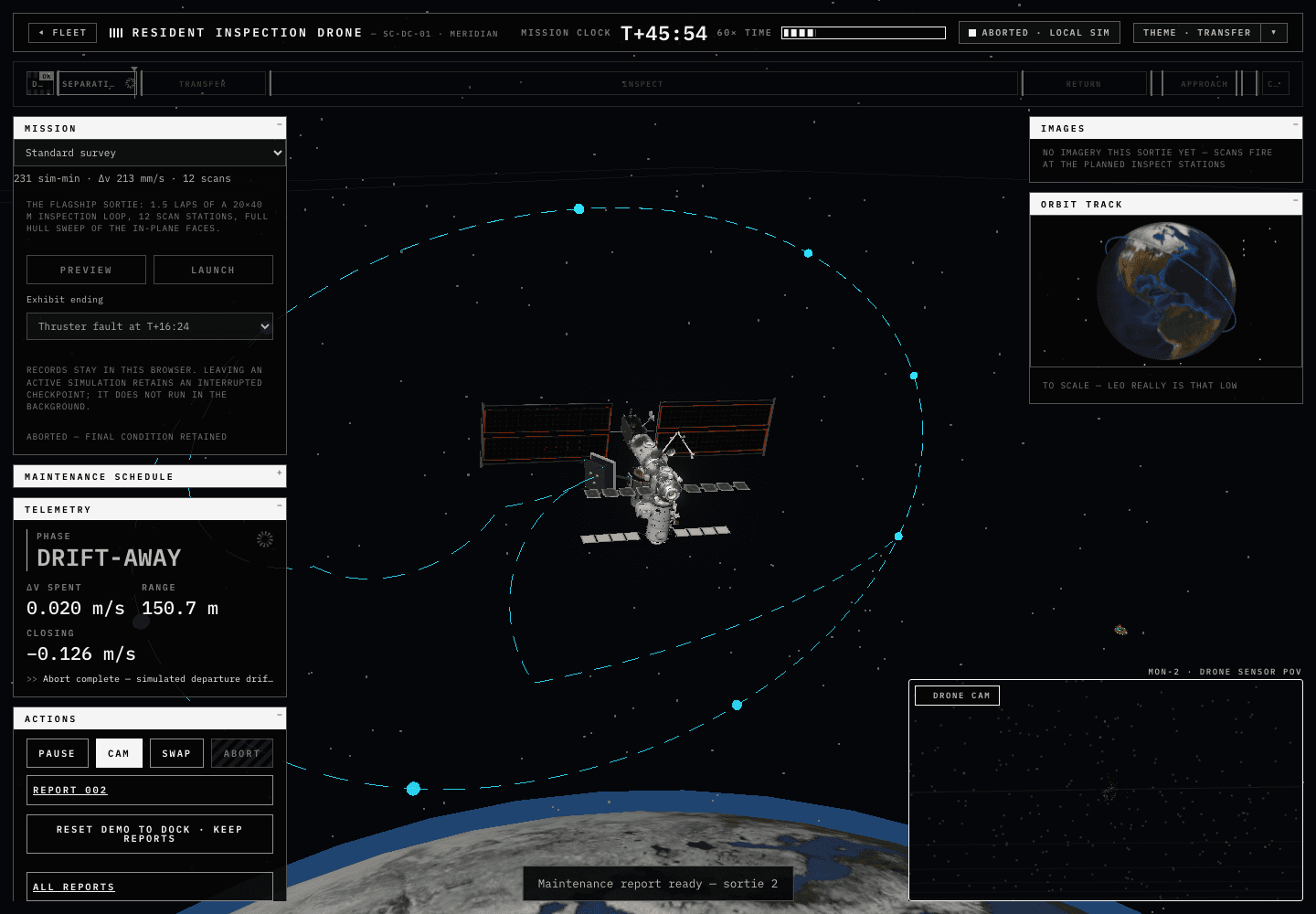
The fault cancels the transfer action. The final drift-away condition remains visible in the separate record.
Read the aborted-run reportFurther exploration · 2026. Static exports from tested local runs. Synthetic images and modeled behavior; replay data stays in the originating browser.
My industrial-design background shaped the form factor and garage-and-dock concept. My software work made the system explorable through simulation and visualization. Robotics and simulation are areas I am actively studying; ANGEL gave that learning a concrete system to work on.
I developed research and strategy with AI assistance and built with Claude Code, recording architectural decisions in one context file. References, code inspection and tests helped check what the demo could claim. The repaired browser flow completed a 12-station survey with four seeded findings and preserved both mission endings across reload. Those are software-behavior results, not inspection-accuracy statistics.
ANGEL remains a personal concept and simulation, with no flight hardware or operational deployment. Imagery is synthetic; docking and visual attitude include scripted choreography. The newer reports iteration covers the browser-local path, not the optional Python WebSocket server’s legacy reports. The demo does not establish flight readiness or real-world mission safety.
The newer browser-local lifecycle and reports iteration has been tested locally and is not yet on this hosted deployment.
Concept, systems design and simulation: Xiang Gao, with AI-assisted research and implementation. Visual assets: NASA/JSC Gateway Program Office; Gateway model by Alberto G. Bertolin and Bradley W. Reynolds, JSC Graphics and Animation Lab; NASA Blue Marble imagery. NASA models are illustrative stand-ins, not original ANGEL spacecraft designs.